Gridfinity generator: bins and baseplates
Type the size, like 3x2x6 Gridfinity bin or 4x3 Gridfinity baseplate with magnets. Cad Bot builds it on the 42 mm grid and gives you an STL to print, a STEP to edit and a DXF drawing. Same compiler as text to CAD, so the dimensions are exact rather than approximated.
1 free generation without an account, then 1 per day once you sign in. Parameter edits are always free.
STEP, shop drawings, and outline upload come with credit packs and Pro.
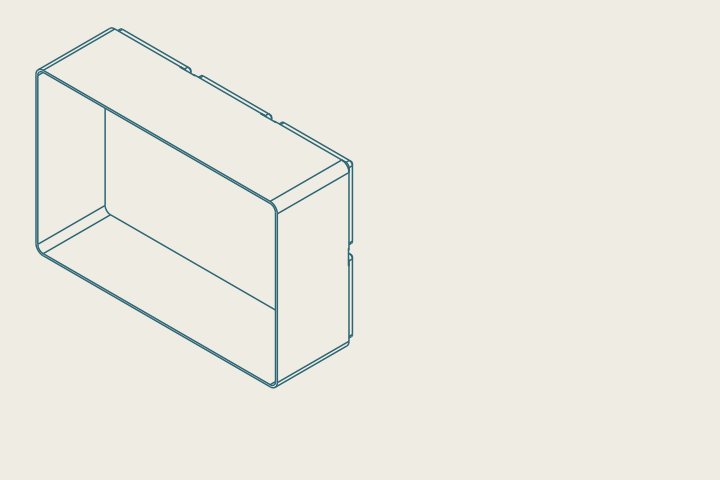
Bin 3×2×6 · example · press BUILD SOLID
SCROLL TO ZOOM · DRAG TO PAN
· drag to rotate · press BUILD SOLID
What you can generate
- Bin: 1 to 8 cells wide and deep, 2 to 12 height units. Type 3x2x6 for 3 cells by 2 cells by 6 units (42 mm of body, 46.4 mm with the lip). Walls are 0.95 mm, and the top carries the stacking lip.
- Baseplate: 1 to 8 cells each way. Without holes it is an open lattice 5 mm tall; with magnets or screws it gets a 3.4 mm floor to carry the holes, 8.4 mm in all.
- Magnet and screw holes on the baseplate: Ø6.5 × 2.4 mm magnet holes from below and Ø3.4 mm M3 holes, four per cell.
Not built yet: dividers, label tab, scoop, lids, lite bins and weighted baseplates. Asking for one is refused with a message that says what is built, so you never get a bin that quietly lacks it.
Gridfinity dimensions used
| Item | Value |
|---|---|
| Grid pitch | 42 × 42 mm |
| Bin footprint per cell | 41.5 mm (0.5 mm gap to the pitch) |
| Height unit | 7 mm, base included |
| Foot profile | 4.75 mm tall: 0.8 mm chamfer, 1.8 mm vertical, 2.15 mm chamfer |
| Stacking lip | 4.4 mm above the body, stepped in 2.6 mm at its base |
| Corner radius | 3.75 mm on the bin, 4 mm on the baseplate cell |
| Baseplate pocket depth | 5 mm, 36.3 mm opening at the bottom |
| Magnet hole | Ø6.5 × 2.4 mm, 13 mm from the cell centre on both axes |
| Screw hole | Ø3.4 mm |
| Bin wall | 0.95 mm |
These are the values used by the open-source Gridfinity Rebuilt OpenSCAD library, the most common reference. Gridfinity has no single official drawing, so treat them as the common convention, and print one cell before a full drawer.
Sizing a drawer
Cells = drawer length ÷ 42, rounded down, for each direction. A 300 × 330 mm drawer takes 7 × 7 cells with 6 mm and 36 mm left over. A bed that is 256 mm wide prints 6 cells (252 mm), so split a wider grid into several baseplates and set them side by side.
Gridfinity files for Fusion 360, SolidWorks and 3D printing
The STL is checked for a watertight mesh and thin walls before you download it. The STEP opens as a real solid, so add a label tab, dividers or a lip in CAD and keep the exact foot. The three-view drawing comes as DXF and DWG. For other workshop shapes see the parts catalog.
Gridfinity generator questions
What is Gridfinity?
A modular storage system for workshops: a baseplate of 42 mm square cells screwed into a drawer, and bins whose feet click into those cells. Bins come in whole cells wide and deep and whole 7 mm steps high, so they can be rearranged without measuring anything.
What can the Gridfinity generator make?
Bins from 1×1 to 8×8 cells and 2 to 12 height units (14 to 84 mm of body, plus a 4.4 mm stacking lip), and baseplates from 1×1 to 8×8 cells, with or without magnet and screw holes. Each is one solid you can download as STL or STEP, with a three-view drawing as DXF, DWG, SVG and PDF.
What does the bin not have yet?
The bin has a 4.4 mm stacking lip on top for another bin to sit against. It can carry magnet and screw holes in its corners, but it has no dividers or compartments, no label tab, no scoop, and there is no lid. Ask for one of those and Cad Bot says so instead of returning a bin without it. Lite bins and weighted baseplates are also not built.
Will it fit other Gridfinity baseplates and bins?
The dimensions follow the values most generators use (the open-source Gridfinity Rebuilt OpenSCAD library): 42 mm pitch, 41.5 mm bin footprint, a 4.75 mm foot with 0.8, 1.8 and 2.15 mm steps, a 5 mm baseplate pocket. A Cad Bot bin seats in a Cad Bot baseplate with no overlap. Gridfinity has no single official drawing, and printers differ, so print one cell of a bin and a baseplate first and check the fit before printing a drawer's worth.
How many cells fit my drawer?
Divide the drawer's inside length and width by 42 and round down. A 300 mm drawer takes 7 cells (294 mm) with 6 mm spare. The largest size here is 8 cells, 336 mm. Check your printer too: a 256 mm bed prints at most 6 cells (252 mm), so make larger grids as several baseplates.
How do I add magnets?
Say "with magnets" on a bin or a baseplate. Each cell corner gets a Ø6.5 × 2.4 mm hole from underneath, sized for 6 × 2 mm magnets; a bin also gets a solid corner post around each hole, since its foot is open inside. Add "and screw holes" for Ø3.4 mm M3 holes in the same corners. A bin with holes is limited to 6 cells a side (a bin without holes goes to 8), because the drawing of a larger one takes too long to build; a baseplate with holes can still be 8.
Which file formats do I get?
STL for 3D printing, STEP for Fusion 360, SolidWorks, Onshape or FreeCAD, and an A4 three-view drawing as DXF, DWG, SVG and PDF. The STEP is a real solid, so you can add a lip, dividers or a label in CAD and keep the Gridfinity foot.
Is the Gridfinity generator free?
The free tier (1 without an account, then 1 per day once you sign in) downloads STL. STEP, DXF, DWG, SVG, and PDF, and outline upload, are on credit packs and Pro. Parameter edits are free.