Geneva mechanism: how it works, and a Geneva wheel generator
A Geneva drive turns a spinning crank into a step-by-step turn of the wheel. Below is the motion explained with the formulas to size one, and a generator for the driven wheel (the Maltese cross) as an STL to print, a STEP to edit and a DXF drawing. Same compiler as text to CAD.
1 free generation without an account, then 1 per day once you sign in. Parameter edits are always free.
STEP, shop drawings, and outline upload come with credit packs and Pro.
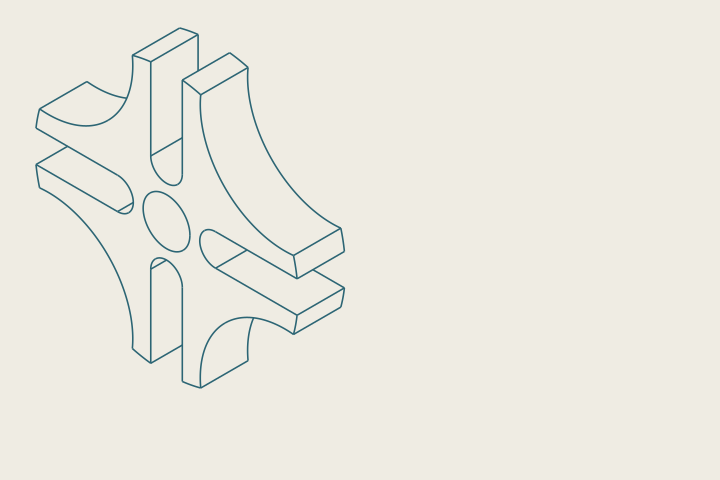
4-slot, Ø40 · example · press BUILD SOLID
SCROLL TO ZOOM · DRAG TO PAN
· drag to rotate · press BUILD SOLID
How a Geneva mechanism works
The drive has two parts. The driver is a crank with one pin and a round locking disc, turning at constant speed. The driven wheel has radial slots and concave arcs between them. For most of each turn the locking disc rides in one of the arcs, so the wheel cannot move. Once per revolution the pin slides into the next slot, pushes the wheel round one step, and leaves; the disc then locks the wheel again.
Because the pin enters the slot at a right angle to the line between the shafts, the wheel starts and stops with no jerk. That is why the mechanism is used where a part must be indexed and held still: film projectors, rotary indexing tables, counters and escapements.
Geneva drive formulas
For a wheel with n slots and a centre distance a between the two shafts:
- Crank radius r = a × sin(180° / n)
- Distance from wheel centre to the pin at engagement = a × cos(180° / n)
- Wheel step per driver revolution = 360° / n
- Driver angle while the pin is in the slot = 180° − 360° / n
- Dwell (wheel stopped) = 180° + 360° / n of each driver revolution
- The slot must be long enough to reach in to a − r from the wheel centre, plus the pin radius
For four slots, r = 0.707 × a, the wheel steps 90° and the crank drives it for 90° of each turn. With a = 40 mm the crank radius is 28.3 mm. A six-slot wheel has r = 0.5 × a and steps 60°.
What the generator makes
The generator builds the driven wheel as one solid: 4 to 12 slots with rounded inner ends, concave locking arcs between them, and the outer diameter and bore you set. The proportions follow the formulas above, so the slot depth matches the pin's closest approach rather than being a drawing of a cross. Thickness is 18% of the diameter, never under 6 mm. It does not generate the crank or locking disc and does not place the pair at a centre distance.
Describe it in one line: 6-slot Geneva wheel, 50 mm outer diameter, 8 mm bore. Any size you leave out is assumed, and the assumption is printed next to the download bar. A ratchet wheel or a cam is not a Geneva wheel and is built as its own part.
Geneva wheel for 3D printing, Fusion 360 and SolidWorks
The STL is checked for a watertight mesh and thin walls before you download it. The STEP opens as a real solid in Fusion 360, SolidWorks, Onshape or FreeCAD, so you can cut the slots deeper, add a hub, or draw the crank on the same centre distance. The three-view drawing comes as DXF and DWG.
Building the mating gears of a drive instead? See the gear generator for spur gears, racks and sprockets, or the parts catalog for the other mechanism parts.
Geneva mechanism questions
What is a Geneva mechanism?
A Geneva drive (also called a Maltese cross) turns constant rotation into stop-and-go rotation. A driver crank carries a pin that enters a radial slot in the driven wheel, advances it one step, leaves, and a locking disc then holds the wheel still until the pin comes round again. Film projectors, indexing tables and mechanical counters use it.
What does Cad Bot generate?
The driven wheel: a disc with 4 to 12 radial slots (rounded at the inner end, open through the rim) and concave locking arcs between them, with the outer diameter and bore you give. It is one solid you can download as STL or STEP, with an A4 three-view drawing as DXF, DWG, SVG and PDF. It does not generate the driver crank or the locking disc, and it does not place the two parts at a centre distance.
Can I choose the number of slots?
Yes, from 4 to 12: say "6-slot Geneva wheel" or "Geneva wheel with 8 slots". Four is the default, the common 90° indexer. A three-slot wheel is not offered because its hub is too small to hold a shaft.
How do I size the crank for my wheel?
Pick the centre distance a between the driver and wheel shafts. For a wheel with n slots the crank radius is r = a × sin(180°/n), and the pin meets the slot a × cos(180°/n) from the wheel centre. For four slots r = 0.707 × a. The generator sizes the wheel the other way round: it sets a so the engagement point sits at 90% of the wheel radius, which is the a printed on the drawing notes after you build. Cad Bot does not draw the crank, so use that a and r in your CAD.
How far does the wheel turn, and how long does it dwell?
The wheel advances 360° / n per driver revolution. The driver turns 180° − 360°/n while the pin is in the slot, so a four-slot wheel moves during 90° of the crank and rests for the other 270°. More slots mean a longer motion window and a smaller step.
Is a 3D-printed Geneva wheel strong enough?
For light indexing it can be. Print it flat with at least 3 perimeters, and use a steel or brass pin on the crank rather than a printed one. The slots run in toward the hub, so the bore has a limit: the generator refuses a bore that leaves less than a minimum wall to the slot ends and tells you the largest one. A Ø40 four-slot wheel takes up to about Ø7; for a larger shaft make the wheel bigger or add a hub in CAD.
Is the Geneva wheel generator free?
The free tier (1 without an account, then 1 per day once you sign in) downloads STL. STEP, DXF, DWG, SVG, and PDF, and outline upload, are on credit packs and Pro. Parameter edits are free.